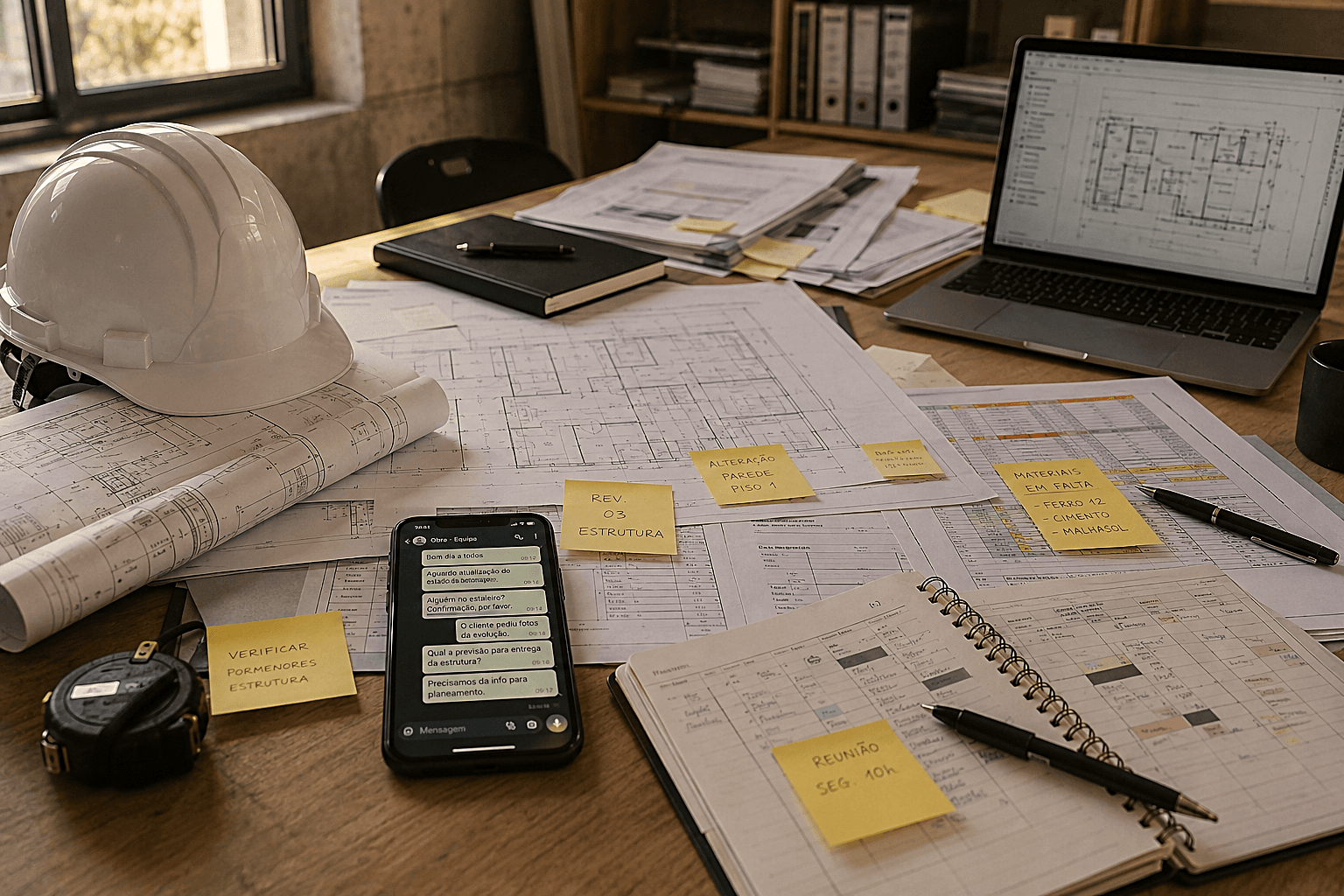
Why the status of a job site still depends on asking
A job site is rarely short on information. It has too much of it, scattered across too many places — and that's what forces someone to ask before anyone can decide.

A job site is rarely short on information. It has too much of it, in too many places at once.
The budget is in a file. Yesterday's change is in a WhatsApp message. The missing material is in the foreman's head. The crew that didn't show up is in a call nobody logged. Every piece exists — it just doesn't exist in the same place.
The question that shouldn't be necessary
When someone needs to know how a specific site is doing, the answer is rarely immediate. It means calling the foreman, opening the right group chat, finding the right sheet, checking with whoever was there this morning. No one is hiding information — it's simply spread across people who each know only their own piece of it.
With one site, that's a minor annoyance. With six or seven running at the same time, it becomes the job itself: instead of deciding where to step in, the day is spent reconstructing what already happened.
What usually gets tried
The most common response is to add more communication: one more WhatsApp group, a shared spreadsheet, a weekly status meeting.
- The WhatsApp group grows until it's impossible to find the message that actually matters
- The spreadsheet only reflects what someone had time to write down after it already happened
- The weekly meeting always shows the past — never what's changing right now, on site
None of these fixes are wrong. Each helps a little. But none of them addresses the cause: they all still depend on someone remembering to report, and someone else remembering to ask.
What this reveals
The problem isn't a lack of communication. It's the absence of a single place where the status of each job actually lives — updated the moment it changes, not the moment someone asks about it.
The status of a job should change the moment it changes on site — not the moment someone calls to ask.
This doesn't mean digitizing everything, or replacing the foreman with a system. It means deciding, for each site, which states actually matter — in progress, waiting on materials, blocked, done — and making sure the move from one state to the next is recorded somewhere anyone who needs to know can see it, without asking anyone.
It's a small change to describe and an uncomfortable one to keep putting off: as long as the real status only lives in the head of whoever is on site, every management decision will keep arriving one step behind what's already happening.
Does this pattern sound familiar in your own operation?
If knowing the status of a job still means asking someone, it's worth understanding why before picking a tool.